Based on the original book content, but upgraded, a new article was published in Autumn 2025 – Gower’s famous Patella Beach: deposit of a catastrophic storm. Gower Journal Vol. 76, pp. 35-45. The article describes important geological deposits that are exceptionally well preserved on Gower. They are of international significance in reflecting a past climate. Although studied and reported since the 1800s, the so-called Patella Beach is not a common type of beach deposit. In the article it is interpreted as recording a supremely energetic and devastating super-storm, during which debris was catastrophically dumped far beyond any contemporary beach and reach of tides. Such an event today would devastate our coastal settlements.
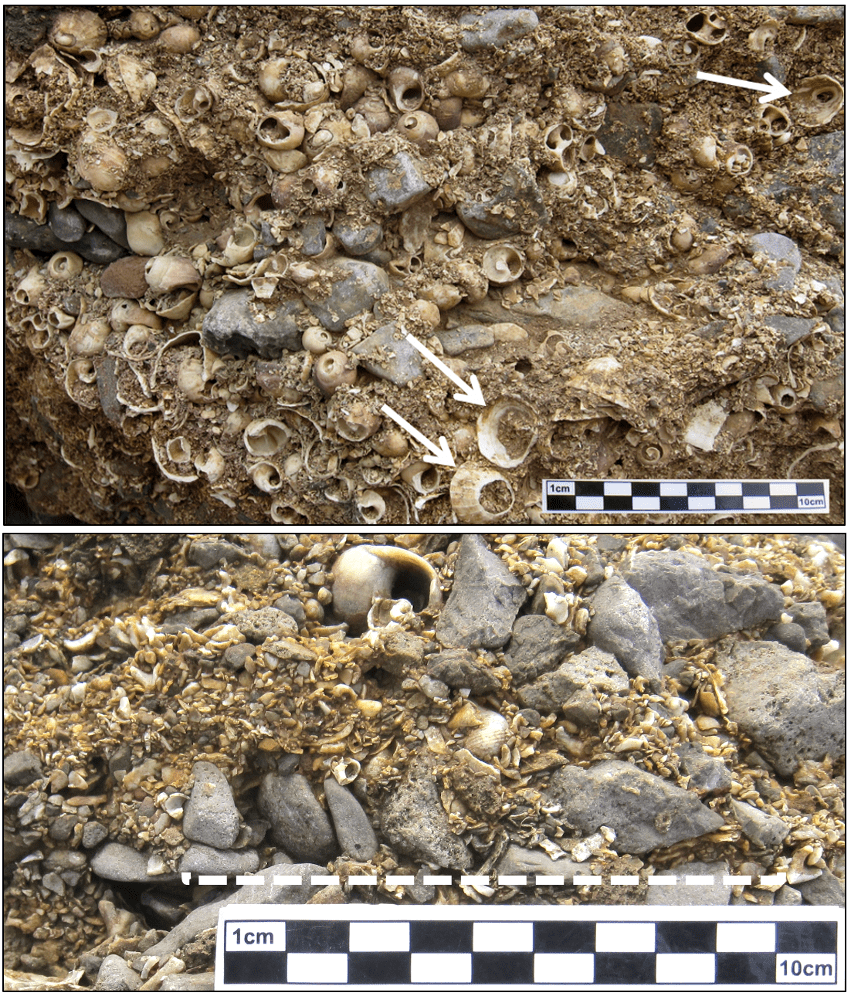
Patella Beach was named for its content of thick-shelled common limpets (Patella vulgata; white arrows), although there are also abundant various periwinkles (Littorina littorea and L. rudis, and Melarhaphe neritoides) and dog whelk (Nucella lapillus), with myriad fragments including other species. The photos are of vertical sections, respectively from the southwest shore of Oxwich Point (SS504849), and the east shore of Deep Slade (SS564866). Characteristic of the Patella deposits are (i) gradations from shelly gravels into poorly sorted coarser layers rich in limestone fragments, (ii) varying angularity versus rounding of rock fragments, (iii) absence of fine sand or silt, and (iv) the robust nature of the surviving shells. Locally, the larger and more tabular rock fragments show ‘jamming fabrics’ (oblique alignment or imbrication), here, like books on a shelf, arranged sub-parallel to one another and at a steep angle to the bedding, as in the stack above the dashed line in the lower image. Mostly the deposits are firmly cemented by calcite deposited from percolating water.
For the full account: Kokelaar P (2025) Gower’s famous Patella Beach: deposit of a catastrophic storm. Gower Journal, Volume 76, pp. 35-45.
 Gower Landscape - a recent book and a new project